Is Space Truly Empty? The Quantum Vacuum, Big Bang, and Dark Energy
The Illusion of the Cosmic Void
Gazing into the deep night sky, the universe appears overwhelmingly empty. Trillions of stars and billions of luminous galaxies drift across unfathomable distances. Yet across cosmological scales, baryonic matter accounts for less than five percent of the total cosmic energy budget. The vast majority of the cosmos consists of deep space. But is this cosmic void truly barren and inactive, or is it alive with unseen physics?
To answer this question, physics looks first into the microscopic architecture of ordinary matter. Inside a hydrogen atom, a single proton occupies the nucleus, encircled by a lone electron. Yet over $99.999999999999\%$ of an atom’s volume is physically empty. If all the empty space within the atoms composing the Earth were removed, our entire planet would compress into the volume of a tennis ball while preserving its full mass. Empty space is the primary fabric of both the microcosm and the macrocosm.
The Quantum Vacuum: A Boiling Sea of Virtual Particles
In classical Newtonian mechanics, a vacuum was defined as a pure, static absence of matter. Modern quantum field theory has completely overturned this intuition with the concept of the quantum vacuum.
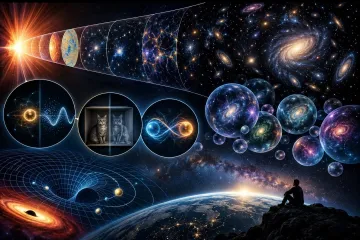
According to the Heisenberg Uncertainty Principle ($\Delta E \Delta t \ge \hbar / 2$), the energy of a localized quantum field cannot remain permanently fixed at zero. Instead, vacuum states undergo relentless, spontaneous fluctuations. Within this restless boiling sea, pairs of virtual particles and antiparticles—such as electrons and positrons—spontaneously erupt from nothingness, interact, and annihilate back into energy within fractions of a femtosecond. Macroscopic physical manifestations, such as the Casimir effect and the Lamb shift in hydrogen spectroscopy, provide decisive experimental proof that the quantum vacuum possesses real, measurable zero-point energy.
Quantum Fluctuations and the Genesis of the Cosmos
Astrophysicists believe that the entire observable universe owes its existence to these microscopic vacuum fluctuations. In standard inflationary cosmology, the cosmos began approximately $13.8$ billion years ago at an ultra-dense, ultra-hot singularity.
During the inflationary epoch ($10^{-36}$ to $10^{-32}$ seconds after the Big Bang), a tiny patch of space expanded exponentially. This runaway cosmic inflation stretched subatomic quantum vacuum fluctuations to astronomical scales. Tiny density variations became frozen into the metric of expanding spacetime, creating the gravitational seeds that later gathered primordial hydrogen and helium into the first stars, protogalaxies, and colossal cosmic webs.
Dark Energy: The Pressure of Empty Space
The role of the cosmic vacuum extends into the modern fate of the universe. In 1998, observational cosmologists studying Type Ia supernovae discovered that cosmic expansion is not decelerating under gravitational attraction, but accelerating outward.
This cosmic acceleration is driven by an invisible repulsive force permeating all space, termed dark energy. Comprising roughly $68\%$ to $70\%$ of the universe, dark energy acts as an intrinsic energy density of empty space itself—a cosmological constant ($\Lambda$). Theoretical physicists suspect that dark energy is intimately linked to the vacuum energy of quantum fields, though bridging the $120$-order-of-magnitude discrepancy between quantum field theory predictions and cosmological observations remains the greatest challenge in modern theoretical physics.
Conclusion
The empty void of space is far from sterile. From the subatomic fluctuations of the quantum vacuum that birthed the primordial galaxies to the dark energy driving the accelerating cosmos, empty space is the dynamic stage orchestrating all cosmic reality.