The Double-Slit Experiment: Wave-Particle Duality and Quantum Reality
The Classical Debate: Particles Versus Waves
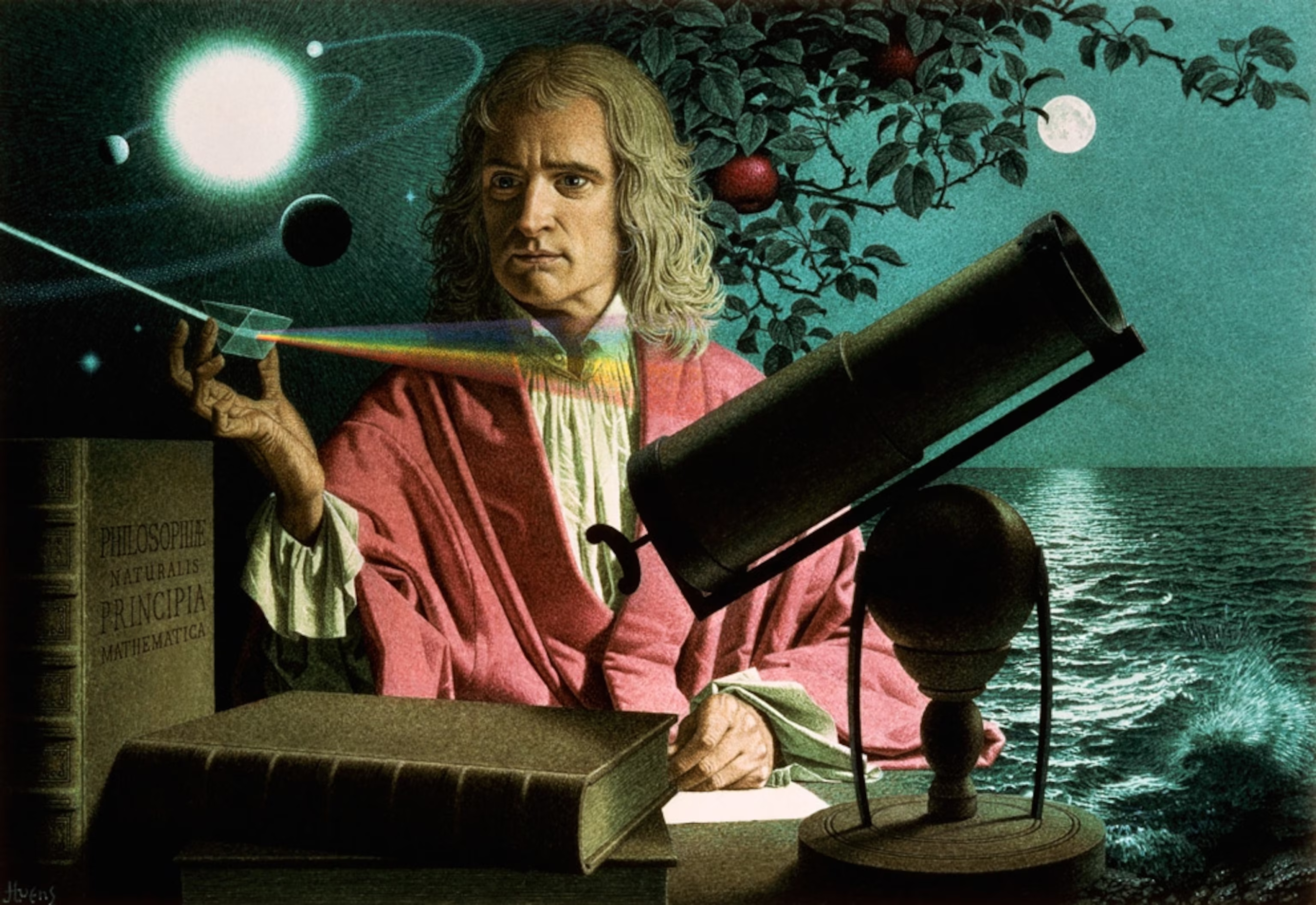
During the seventeenth century, Sir Isaac Newton conducted extensive optical investigations, concluding that light consists of tiny, discrete particles or “corpuscles” traveling in straight lines. However, Newton’s corpuscular theory struggled to explain phenomena such as optical diffraction and partial reflection.
In 1801, British polymath Thomas Young designed a deceptively simple apparatus that definitively challenged the particle doctrine: the historic double-slit experiment. Directing sunlight through two narrow, parallel slits onto a viewing screen, Young observed not two discrete bands of light, but an intricate alternating pattern of bright and dark fringes. This was an unmistakable signature of wave interference. Where wave crests met constructively, luminous bright fringes appeared; where crests met troughs destructively, darkness prevailed. For the next century, physics considered the wave nature of light an established empirical fact.
Einstein, the Photoelectric Effect, and the Photon
This classical consensus was disrupted in 1905 when Albert Einstein explained the photoelectric effect. Einstein demonstrated that light transfers energy not continuously, but in localized discrete packets of energy called quanta—later named photons. For this discovery, which proved that light exhibits particulate behavior during emission and absorption, Einstein was awarded the 1921 Nobel Prize in Physics.
How could light behave simultaneously as an extended continuous wave and a localized discrete particle? Quantum mechanics answered with the concept of wave-particle duality: microscopic physical entities possess dual natures, behaving as waves or particles depending upon the experimental apparatus used to observe them.
Electrons in the Double Slit: Matter Waves in Action
In 1924, French physicist Louis de Broglie hypothesized that if light waves possess particle characteristics, material particles such as electrons must conversely possess wave characteristics ($lambda = h/p$).
To test this hypothesis, physicists adapted the double-slit experiment for matter, directing a beam of electrons through an electron bi-prism toward a detector screen. Astonishingly, electrons formed the exact same alternating interference fringes as light waves. Even more remarkably, when physicists fired electrons through the apparatus one by one—ensuring only a single electron existed in the apparatus at any given moment—the individual localized hits gradually built up the collective wave interference pattern over time. A single electron appeared to pass through both slits simultaneously, interfering with itself as an extended wave function.
The Observer Effect and Wave Function Collapse
To determine which slit each electron actually traversed, researchers placed detectors directly adjacent to the slits. The result shook the foundation of classical physics: the moment detectors tracked the electron’s path, the interference pattern vanished completely, replaced by two classical particle bands.
In quantum mechanical formalism, the act of physical measurement forces the distributed probability wave function ($psi$) to collapse into a definite eigenstate. As soon as environmental interaction or measurement determines the particle’s trajectory, its quantum superposition is destroyed. As Nobel laureate Richard Feynman famously remarked, the double-slit experiment contains the heart of quantum mechanics, holding the only true mystery of physical reality.
Conclusion
The double-slit experiment remains the supreme demonstration of quantum weirdness. It exposes the fundamental boundary between the microscopic realm of quantum superpositions and the macroscopic world of classical certainty, forever transforming our understanding of physical reality.