From the Birth of the Universe to the Multiverse: Big Bang and Parallel Worlds
The Grand Scale of Cosmic Geography
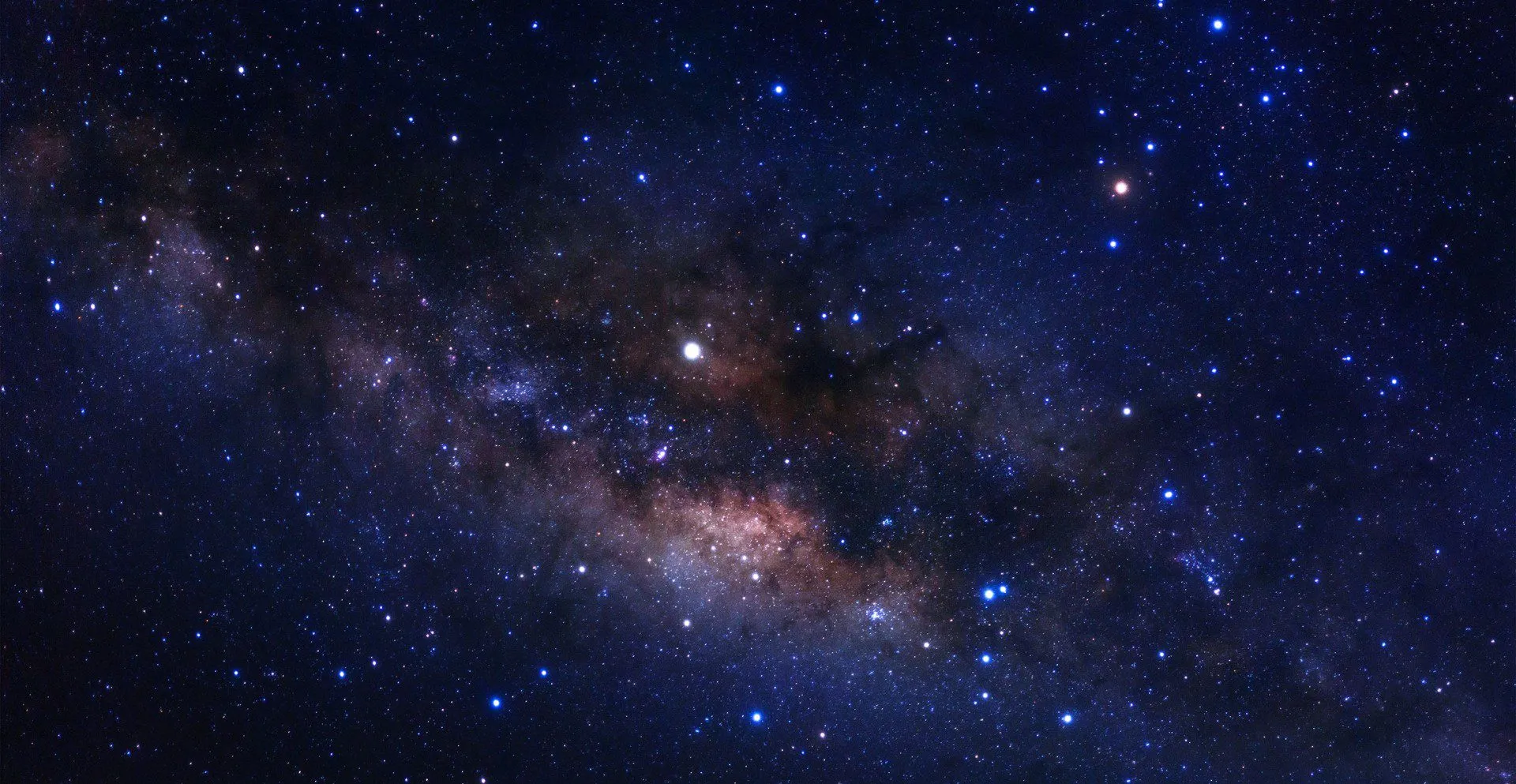
The immense scale of the observable cosmos staggers the human imagination. Deep-field surveys by the Hubble and James Webb Space Telescopes estimate that our observable universe contains hundreds of billions of galaxies. Within our home spiral galaxy, the Milky Way, approximately $100$ to $400$ billion stars reside. Our Sun is merely an ordinary yellow dwarf orbiting near the inner edge of the Orion-Cygnus arm, hosting a terrestrial biosphere that sustains human civilization.
Across the observable cosmos, there are an estimated $10^{22}$ stars—a number exceeding all the grains of sand on every coastline on Earth. Yet only a century ago, mainstream astronomy believed the Milky Way constituted the entire universe. In 1923, Edwin Hubble measured Cepheid variable stars in the Andromeda nebula, proving it was an independent island universe $2.5$ million light-years away and expanding human horizons into deep extragalactic space.
The Big Bang and the Cosmic Singularity
Spectral redshift measurements revealed that distant galaxies are racing away from us, proving that spacetime itself is dynamically expanding. Extrapolating cosmic expansion backward in time, all matter and energy converge approximately $13.8$ billion years ago into an initial state of infinite density and temperature: the cosmic singularity.
The rapid expansion from this state, termed the Big Bang, created spacetime and baryonic matter. Direct observational evidence for this genesis arrived in 1964 with the detection of the Cosmic Microwave Background (CMB) radiation by Arno Penzias and Robert Wilson—a relic thermal glow permeating the sky at $2.725\text{ K}$. During the first three minutes of cosmic nucleosynthesis, cooling energy crystallized into fundamental quarks and leptons, forging the primordial hydrogen and helium that seeded the cosmos.
Quantum Strangeness: Superposition and Measurement
While general relativity explains cosmic macro-structures, quantum mechanics governs the subatomic foundation of matter. In the quantum realm, deterministic Newtonian trajectories give way to probabilities:
- Quantum Superposition: Particles can exist simultaneously in multiple overlapping physical states until an observation forces the wave function to collapse.
- Schrödinger’s Cat: Erwin Schrödinger formulated his famous thought experiment to highlight the bizarre paradox that occurs when microscopic quantum superpositions are amplified to macroscopic systems.
- Quantum Entanglement: Entangled particle pairs exhibit instantaneous correlations across vast spatial distances, defying classical notions of local realism.
Hugh Everett and the Many-Worlds Interpretation
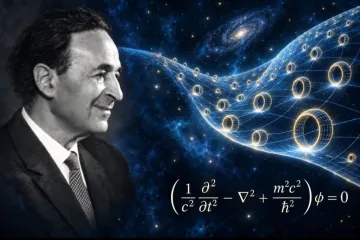
In 1957, Princeton physicist Hugh Everett III proposed a radical resolution to the quantum measurement problem: the Many-Worlds Interpretation (MWI). Everett asserted that the wave function never collapses. Instead, every time a quantum measurement occurs with multiple possible outcomes, the universe branches into mutually unobservable parallel realities. In this framework, every possible history and choice plays out within an ever-proliferating cosmic ensemble.
Cosmic Inflation and the Multiverse Theory
Modern theoretical physics arrived at the multiverse theory by uniting quantum field theory with inflationary cosmology:
- Eternal Inflation: Cosmologist Alan Guth and Andrei Linde proposed that primordial inflation did not stop everywhere at once. While inflation ended in our observable pocket, surrounding spacetime continues to expand exponentially, continually spawning isolated “bubble universes.”
- String Landscape: String theory posits that fundamental physical reality contains ten or eleven dimensions, with extra spatial dimensions curled into Calabi-Yau manifolds. With an estimated $10^{500}$ stable geometric configurations, different universes in the multiverse may operate under entirely distinct physical constants and fundamental forces.
Conclusion
From the fiery birth of our universe in the Big Bang to the dizzying horizons of multiverse theory, theoretical cosmology continues to redefine the boundaries of existence. Within this infinite cosmic tapestry, human curiosity—anchored in an organ weighing barely 1.5 kilograms—dares to map the architecture of parallel realities.